

An ankle sprain is the most common injury of the lower limb and results from excessive stretching or tearing of the ligaments of the ankle. It can be a serious injury that may occur during sport, but it can equally result from simply putting your foot down awkwardly.
Excessive twisting of the ankle damages its ligaments and its stability, so that recovery from an ankle sprain can be a lengthy process. For complete healing and for the full restoration of strength and mobility to the affected ankle — whatever the extent of the injury — the patient must be under careful medical supervision and follow the instructions given.
Without appropriate treatment and rehabilitation, carried out in good time and completed within the period set by the doctor, the ligaments of the ankle can remain unhealed, and as a result ankle sprains will continue to recur. This leads to a range of conditions, significantly reducing patients' ability to enjoy an active life. For this reason, prevention is necessary in the activities we carry out daily, along with careful attention to medical advice given exclusively by specialists.
The ligaments of the ankle — what happens when you twist your ankle
The ankle is supported by several ligaments, and the injury affects not one but a group of them. The ankle ligaments serve to anchor the bones of the lower leg to the bones of the foot; those affected are the anterior and posterior talofibular ligaments and the calcaneofibular ligament. Depending on the location of the damage, sprains can be lateral, medial or high — above the level of the ankle.
How it happens
An ankle sprain can occur both during sport and during everyday activities. Running with the feet incorrectly positioned, injury during exercise, and going down or up steps can all trigger this condition, as a result of the ankle twisting excessively inwards through inversion or outwards through eversion.
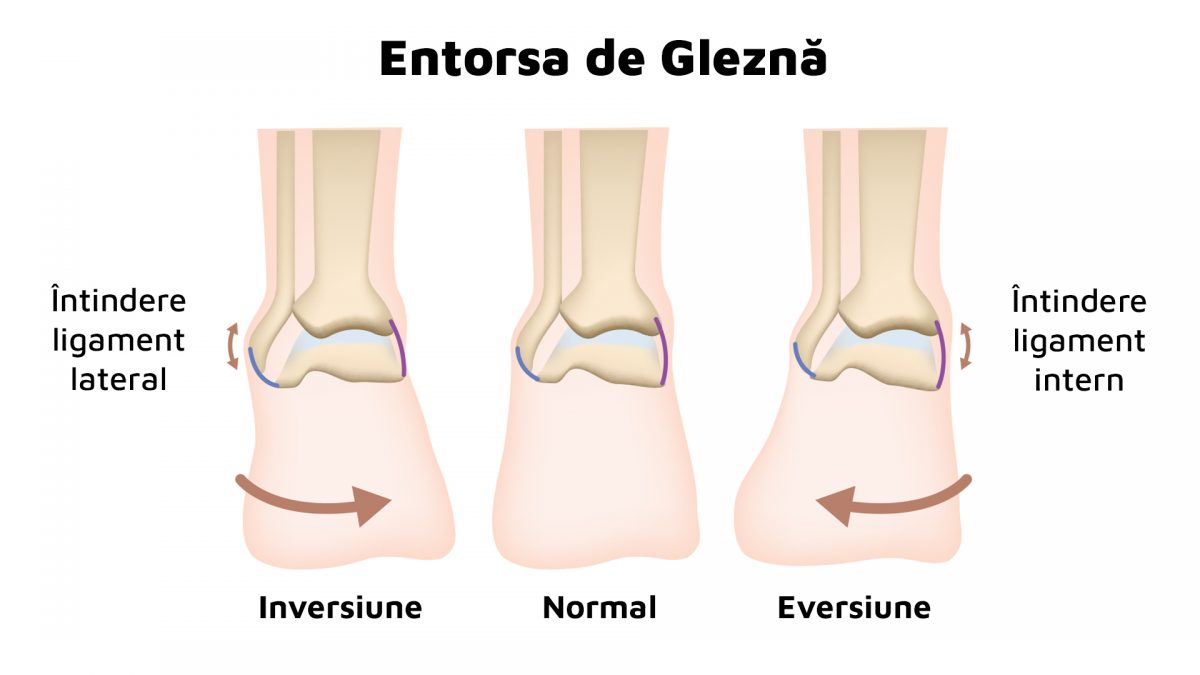
The grades of ankle sprain
Depending on the severity of the injury, an ankle sprain can be of several grades: grade 1, grade 2 and grade 3.
Grade 1 ankle sprain
A grade 1 ankle sprain is mild, with the ligaments stretched rather than torn. With this type of sprain the pain is low in intensity and the joint remains sufficiently stable. A grade 1 ankle sprain does not require surgery.
Grade 2 ankle sprain
In a grade 2 ankle sprain the ligaments are partially torn, and the pain and instability in the ankle are moderate. A grade 2 sprain can be classed as an injury of medium severity.
Grade 3 ankle sprain
A grade 3 ankle sprain is the most severe of those mentioned and involves complete rupture of the ligaments. In this case the instability of the ankle and the pain are very pronounced, and in certain situations surgery will be needed to repair it.
Symptoms of an ankle sprain
The main symptoms of an ankle sprain are inflammation, a sensation of heat radiating from the ankle, swelling, throbbing in the affected joint, reduced movement in the ankle and the appearance of bruising. These can affect everyday activities, with the patient finding it difficult to stand or walk.
Complications of an ankle sprain
An untreated ankle sprain can lead to complications, increasing the likelihood that the patient will develop a range of other joint problems over time. The complications of an ankle sprain include constant pain, joint instability in the ankle and arthritis. For a correct diagnosis, and to improve the chances of a proper recovery, seeing an orthopaedic specialist early is advisable.
Treating an ankle sprain — repairing the ligaments
Repairing the ligaments of the ankle is more difficult in severe cases, where symptoms persist for several weeks. Treatment for an ankle sprain can be non-surgical or surgical, depending on the grade of the injury.
To treat a medium-grade ankle sprain, immobilisation in a brace and the use of crutches when walking are needed. Physiotherapy is essential for recovery from any sprain. This allows the mobility and strength of the ankle to be restored gradually.
Surgical treatment may be necessary in severe, grade 3 injuries, where mobility is reduced to a minimum, the patient experiences instability and severe pain in the ankle, and is unable to walk.
A rehabilitation protocol for ankle sprains
Once the ankle is no longer swollen and the area is no longer painful, rehabilitation exercises for the ankle sprain can begin, as recommended by the orthopaedic surgeon and the physiotherapist.
Conservative treatment consists of the "RICE" protocol: Rest, Ice, Compression by means of an elastic bandage, and Elevation, by keeping the ankle above heart level. Ice compresses are recommended in the first 2 days after the injury, applied for around 20 minutes every 2–3 hours. As regards compression, it is worth noting that the bandage around the ankle must not be excessively tight, so as to allow normal blood circulation.
Anti-inflammatories can help recovery from an ankle sprain by reducing the intensity of the pain. They should be taken as directed by the doctor.
Exercises for an ankle sprain
The main aims of exercises for an ankle sprain are to increase mobility and strengthen the muscles, and they are necessary in every case. The more severely the ankle is affected, the longer the healing and recovery process takes. It is recommended that rehabilitation be carried out at a physiotherapy centre, under the supervision of specialist medical staff.
One of the exercises recommended at home for restoring mobility involves drawing letters in the air with the big toe of the affected foot. Rehabilitation exercises after an ankle sprain are tailored to each individual patient, bearing in mind the severity of the injury.
FAQ:
Q: How long does an ankle sprain take to heal?
A: Healing time ranges from a few days to a few months, depending on the severity of the injury.
Q: Can you walk with a sprained ankle?
A: With a mild injury, yes. With injuries of medium severity the patient can walk with the ankle immobilised in a brace, and where the ligament is completely torn it is impossible for them to walk.
References:
1. https://www.aafp.org/pubs/afp/issues/2001/0101/p93.html
2. https://www.ncbi.nlm.nih.gov/pmc/articles/PMC4293961/
3. https://www.webmd.com/pain-management/ankle-sprain
4. https://www.webmd.com/a-to-z-guides/ankle-sprain-treatment

am glezna uflata cu arsura puternica ,am calcat stranb de 1 an nu ma durut numa era vânat, nu am mers la doctor .de 3 luni ma arde ,este unflat ce pot face am 84 ani ,se mai poate face ceva sau rămân asa ? mulțumesc
Bună ziua! Un diagnostic poate fi stabilit numai în urma unei consultații, iar apoi vi se recomandă tratamentul potrivit. Vă aștept la Artro Sport Clinic pentru o examinare.
mergeti la doctor (ortoped)
Daca am entorsa fara ruptura, pot sa calc, e umflat de o saptamana ca am mai calcat si solicitat piciorul, acum port orteza la mers si iau antiinflamator, la cat timp dupa ce se retrage umflatura as putea relua sala si activitatea fizica normala?
Bună ziua! După o entorsă este necesară o luna de repaus de la efortul fizic intens, urmată de exerciții de fiziokinetoterapie și mai apoi mers la sală. Umflătura se va retrage treptat.
Acum 14 zile am calcat strâmb,mi s-a spus entorsa glezna gr 1 dar am avut si doua fisuri la zona gleznei,l-am avut in ghips partial si am facut injectiiclexan,am repetat radiografia si fisura este la fel,numai ca ghipsul s-a fisurat si am luat orteza dar transpira piciorul rau de la acea captusală aceea fiind foarte udă o pun mereu la uscat,plasticul este f dur,fac clexan in continuare ,dar apa de la aceasta captuseală mă zapaceste.Ce trebuie sa fac in continuare si cât timp?Va multumesc.
Bună ziua! Trebuie să efectuați un RMN gleznă 1,5/3 Tesla și apoi să veniți la un consult de ortopedie pentru a va evalua. Utilizați șosetă lungă de bumbac în botina pe care o purtați, pe care să o schimbați de 2-3 ori/zi. Mulțumesc!