
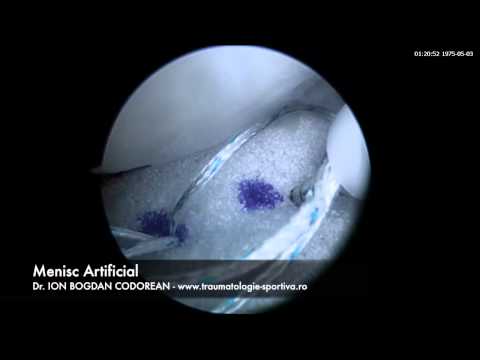
An ACTIFIT artificial meniscus is a honeycomb-like structure that allows blood to flow through it and provides an anchor for a new, growing layer of cells. This is how the natural healing process takes place. Once the damaged section of the meniscus has been removed and the resected meniscus has a good blood supply, the Actifit implant is cut to the right size and sutured into place.
Written and medically reviewed by Dr. Ion Bogdan Codorean, senior orthopaedics-traumatology physician. Updated: August 13, 2026.
The patient must have an intact meniscal rim, with the anterior and posterior horns present, in order to allow the Actifit to be attached. The procedure is performed arthroscopically, usually under general or spinal anaesthesia. If the original meniscal lesion cannot be sutured (repaired), the damaged tissue is removed much as in a partial meniscectomy, until an area with good blood flow is reached.
Only orthopaedic and sports medicine surgeons experienced in treating patients with meniscal tears, and trained in the use of the device, may use the Actifit implant.
Actifit supports the body's natural healing process through a material that allows the affected area to become vascularised and to receive the oxygen, nutrients and fibroblasts needed for cell growth.
A meniscal injury is normally repaired by removing the damaged or torn tissue through a partial meniscectomy. This can be effective in the short term, but usually only relieves the pain partially. In many cases the pain returns over time, because of the loss of meniscal tissue and of its shock-absorbing function.
Actifit is a honeycomb-like structure that allows blood to flow through it and provides an anchor for the new, growing layer of cells. Over time, the new cellular tissue matures into meniscus-like tissue. This helps restore the shock-absorbing function of the meniscus and delay the onset of osteoarthritis.
With Actifit, patients can benefit from pain relief through a single procedure. Over time, the new meniscus-like tissue grown with Actifit improves patients' chances of a future free from pain, loss of mobility, cartilage destruction and the other forms of degeneration that normally lead to osteoarthritis and total knee replacement.
Clinical studies in humans show a significant reduction in pain and promising results in terms of quality of life and return to pre-injury activity levels.
The knee is the most complex joint in the body. The menisci are crescent-shaped fibrocartilaginous structures (the lateral and medial meniscus) located between the femur and the tibia. At least two thirds of the meniscus is thin and avascular (it has no blood supply). Around 80% of meniscal injuries occur in the avascular zone, where successful long-term tissue repair is not possible.
Many of these tears commonly occur in sporting accidents. A sudden twist of the knee, which can pinch or tear the meniscus, is the most frequent cause. At present, if the injury is in an avascular zone, there is only one surgical option and the tissue is removed through a partial meniscectomy.
Dr. Codorean offers a precise diagnosis and a personalised treatment plan.