
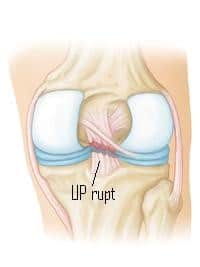
A posterior cruciate ligament tear is a relatively rare knee condition that results from a high-energy injury. Common causes of a posterior cruciate ligament tear are impact with the dashboard in car accidents, or impact with the ground when the knee is flexed.
Written and medically reviewed by Dr. Ion Bogdan Codorean, senior orthopaedics-traumatology physician. Updated: August 14, 2026.
The knee joint is made up of three bones: the femur, the tibia and the patella (kneecap). The bones are interconnected by ligaments. There are four main ligaments in the knee, which act like strong cords holding the bones in contact and stabilising the knee.
These are located on the sides of the knee. They control sideways movement at the knee and stabilise the joint in the frontal plane.
These are located inside the joint. They cross each other forming an "X", with the posterior cruciate ligament sitting at the back. The cruciate ligaments control the front-to-back stability of the knee.
It prevents the tibia from sliding backwards. It is stronger than the anterior cruciate ligament and is injured less often. The posterior cruciate ligament has two parts that behave as a single structure.
Posterior cruciate ligament injuries involve disruption of the ligament's normal anatomical structure, and are less common than other ligament injuries in the knee. Most often, posterior cruciate ligament injuries occur together with injuries to other structures in the knee: articular cartilage, other ligaments, or bone. Posterior cruciate ligament injuries are classified into three grades. Grade 3 represents a complete tear.
Unlike an anterior cruciate ligament (ACL) tear, a posterior cruciate ligament (PCL) tear is usually a partial injury with the potential to heal on its own. Patients with such injuries can generally return to sport without joint stability problems.
The posterior cruciate ligament can tear in a number of situations. A large traumatic force is usually required.
The typical symptoms of a posterior cruciate ligament tear are:
If the injury is recent, healing without surgery is possible. The orthopaedic surgeon may recommend simple, non-surgical treatment options.
The orthopaedic surgeon may recommend wearing a plaster splint to immobilise the knee. To protect the knee, weight-bearing on the affected leg may also be prohibited through the use of crutches.
As the swelling subsides, the patient begins a rehabilitation programme of specific exercises aimed at strengthening the muscles. Strengthening the muscles at the front of the thigh (the quadriceps) has proven to be an essential factor in a successful recovery.
The orthopaedic surgeon may recommend surgery when there are combined injuries (e.g. multiple ligament tears including the posterior cruciate ligament), or when the patient presents with chronic instability due to the posterior cruciate ligament tear.
The orthopaedic surgeon replaces the torn ligament with a tissue graft. Studies have shown that the best graft source is the semitendinosus and gracilis tendons.
The operation is performed under arthroscopic control, using small incisions. Arthroscopic surgery is far less invasive than open surgery. The benefits include reduced pain, a shorter hospital stay and faster recovery.
Because the graft integrates slowly, the patient can resume sporting activity after approximately six months.
Dr. Codorean offers a precise diagnosis and a personalised treatment plan.