
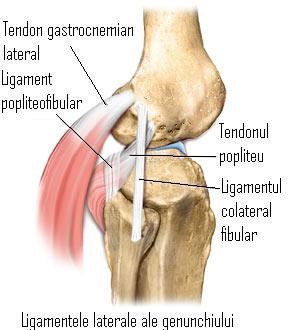
The posterolateral corner of the knee was neglected for a long time. Recent research has yielded valuable insights into this complicated region. Even though injuries to the lateral compartment are relatively rare in sport, an initial misdiagnosis can have devastating consequences for an athlete.
Written and medically reviewed by Dr. Ion Bogdan Codorean, senior orthopaedics-traumatology physician. Updated: August 14, 2026.
One of the reasons this part of the knee remained relatively obscure is that for a long time there was no consensus on how to define it. Today, most orthopaedic surgeons agree on an anatomical description made up of three layers.
Posterolateral corner injuries occur mainly in contact sports, following motorcycle accidents or after falls. Isolated injuries are rare; most often they accompany other ligament injuries. Prompt diagnosis is important for a further reason: delaying treatment of the posterolateral corner can lead to failure of a cruciate ligament reconstruction.
A posterolateral corner injury can cause considerable disability. While walking, the lateral compartment of the knee may open up. Patients prefer to keep the knee flexed in order to prevent this.
Surgical treatment consists of repairing or reattaching the affected structures and should be carried out within the first 2 weeks of the injury whenever possible. Where primary repair is insufficient, or where better stabilisation is desired, the repaired structures can be reinforced using the iliotibial band or the biceps femoris muscle.
Where primary repair is not possible, the alternative is reconstruction. This involves using tendons to rebuild the torn structures. If the posterolateral instability is long-standing, an osteotomy (bone remodelling) may be necessary to correct the malalignment.
Conservative treatment of posterolateral corner injuries consists of wearing a brace, physiotherapy and modifying physical activity. This treatment is recommended for patients with incomplete injuries. The brace should be worn for between 2 and 6 weeks, depending on the severity of the injury.
Physiotherapy plays a very important role, both in strengthening the adjacent structures and in avoiding joint stiffness (limited movement in the knee joint).
It is important to see a good orthopaedic surgeon, who can diagnose the problem early and offer the appropriate treatment.
Dr. Codorean offers a precise diagnosis and a personalised treatment plan.