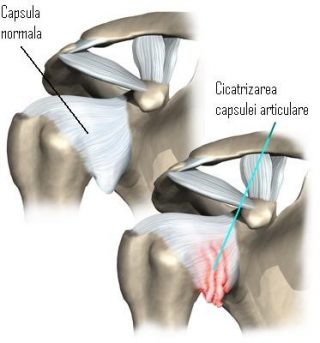
What is adhesive capsulitis, or frozen shoulder
The shoulder joint consists of a spherical surface (the humeral head) positioned in a socket (the glenoid cavity). Around the shoulder joint there is a capsule of connective tissue that envelops the joint. Normally the shoulder joint allows a greater range of movement than any other joint in the body. When a patient develops adhesive capsulitis (or frozen shoulder), the capsule contracts.
Causes of adhesive capsulitis
Most often, adhesive capsulitis appears without any associated injury or detectable cause. Risk factors for developing adhesive capsulitis include:
- Age and sex: Adhesive capsulitis occurs most frequently in patients between 40 and 60, and is twice as common in women as in men.
- Endocrine conditions: Patients with diabetes are at increased risk of developing adhesive capsulitis. Other endocrine abnormalities, such as thyroid problems, can also lead to adhesive capsulitis.
- Shoulder trauma or surgery: Patients who suffer a shoulder injury or undergo shoulder surgery may develop adhesive capsulitis. The risk is greatest when surgery is followed by prolonged immobilisation.
- Other systemic conditions: Several systemic conditions such as heart disease and Parkinson's disease have also been associated with an increased risk of developing adhesive capsulitis.
Symptoms of adhesive capsulitis
The symptoms of adhesive capsulitis include:
- Dull, persistent shoulder pain, which can worsen with movement; usually felt around the shoulder and sometimes in the upper arm
- Restricted movement in the shoulder joint
- Difficulty performing movements such as combing your hair or putting on a t-shirt
- Pain when trying to sleep on the affected shoulder
The stages of a frozen shoulder
- The painful, or freezing, stage: This is the most painful stage. Movement is restricted, but not as much as in the frozen stage. It usually lasts 6–12 weeks.
- The frozen stage: During the frozen stage the pain usually decreases in intensity, but the restriction of movement becomes more pronounced. It can last 4–6 months.
- The thawing stage: This involves a gradual increase in range of movement. It can last more than a year.
Conservative treatment of adhesive capsulitis
A frozen shoulder generally improves without intervention, though this can sometimes take 2–3 years. Treatment focuses on controlling the pain and restoring the range of movement.
Conservative treatment for adhesive capsulitis / frozen shoulder consists of:
- Exercises and stretching — aimed at increasing the range of movement in the shoulder joint and reducing muscle wasting. These exercises should be performed several times a day.
- Physiotherapy — the physiotherapist can help the patient follow an exercise programme, also combining ultrasound, ice, heat and other therapeutic modalities.
- Anti-inflammatory medication — these have not been shown to significantly alter the course of adhesive capsulitis, but they can be useful in reducing pain.
- Cortisone injections — also frequently used to reduce inflammation in a frozen shoulder.
Surgical treatment of adhesive capsulitis
Surgery is considered when there is no improvement in pain or mobility after an adequate period of physiotherapy and anti-inflammatory medication.
The aim of surgery is to stretch the contracted joint capsule. The most common methods are manipulation under anaesthesia and shoulder arthroscopy:
- Manipulation under anaesthesia involves putting the patient to sleep and forcing the shoulder through its range of movement. This process can stretch or tear the joint capsule.
- During arthroscopy, the orthopaedic surgeon makes several incisions around the shoulder. A camera and small instruments are inserted through these incisions. These instruments are used to cut the tightened portions of the joint capsule.
Manipulation under anaesthesia and arthroscopy are often used together to achieve the best results. Recovery time varies, from 6 weeks to 3 months.
See a good orthopaedic surgeon before the shoulder pain gets worse.