
Subacromial impingement is one of the most common causes of shoulder pain in adults. It results from pressure exerted by the acromion (a part of the scapula) on the rotator cuff when the arm is raised.
Written and medically reviewed by Dr. Ion Bogdan Codorean, senior orthopaedics-traumatology physician. Updated: August 14, 2026.
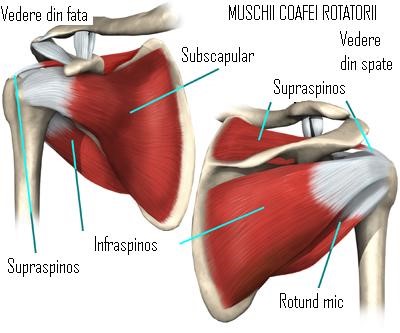
The rotator cuff groups together the tendons of four muscles: supraspinatus, infraspinatus, subscapularis and teres minor. These muscles cover the head of the humerus and work together to raise and rotate the arm at the shoulder.
The acromion, the front edge of the scapula, sits above and in front of the humeral head. When there is not enough space between the acromion and the rotator cuff, the acromion rubs or presses on the surface of the cuff as the arm is raised. This causes pain and limits movement. The rubbing of the acromion against the cuff is known as subacromial impingement.
The pain may be caused by inflammation of the bursa covering the cuff (bursitis) or by tendinitis of the cuff itself.
Subacromial impingement is common both in young athletes and in middle-aged people. Young athletes who use their arms overhead are particularly exposed. Those who carry out overhead activities or repeated lifting of the arm, such as builders or tennis players, are also susceptible. The pain can also appear after minor trauma, or spontaneously with no apparent cause.
The initial symptoms may be moderate. Patients usually do not see an orthopaedic surgeon in the early stages.
As the condition worsens, the pain begins to appear at night. Strength and range of movement decrease, and otherwise ordinary activities such as doing up a zip or buttons can become difficult.
A good orthopaedic surgeon will bring the pain and inflammation under control.
The aim of the operation is to widen the space between the acromion and the rotator cuff tendons. The surgeon must remove the subacromial bone spurs that are damaging the cuff tendons and the bursa. The orthopaedic surgeon usually also removes a small portion of the acromion, to widen the space further. Reshaping the acromion is known as acromioplasty.
Impingement may not be the only problem in an ageing, worn shoulder. It is very frequently associated with degeneration of the acromioclavicular (AC) joint. If AC joint osteoarthritis is also present, a small portion of the collarbone is removed during the impingement operation.
The procedure can be carried out in two ways:
1. The arthroscopic procedure — acromioplasty is most often performed using an arthroscope. The arthroscope is a special camera that can be inserted into the shoulder joint through a small incision in the skin. The result is less surgical trauma, a single day in hospital, and faster healing and recovery.
2. Open surgery — in other cases an incision of roughly 8–10 cm is made, through which the excess bone tissue (spurs and a small portion of the acromion) is removed.
As soon as pain appears, it is advisable to seek the advice of a good orthopaedic surgeon and book a consultation.
Dr. Codorean offers a precise diagnosis and a personalised treatment plan.