
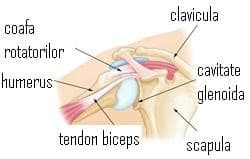
The shoulder is made up of three bones: the upper arm bone (the humerus), the flat shoulder bone (the scapula) and the collarbone. The shoulder is the most mobile joint in the body, involved in lifting and rotating the arm as well as in combined movements. This high degree of mobility, however, comes with reduced stability.
Written and medically reviewed by Dr. Ion Bogdan Codorean, senior orthopaedics-traumatology physician. Updated: August 14, 2026.
Chronic shoulder instability is the inability of the ligaments, tendons and muscles around the shoulder to keep the humeral head centred in the glenoid cavity. Clinically, it manifests as recurrent dislocation or subluxation of the shoulder.
A shoulder dislocation is a situation in which the humeral head comes out of the glenoid cavity. This happens as a result of a sudden injury or of overuse. A shoulder subluxation is a situation in which the humeral head comes only partly out of the glenoid cavity. Once the ligaments, tendons and muscles around the shoulder become lax or tear (as in a first dislocation), the dislocation can recur.
There are three common reasons why a shoulder becomes unstable:
This usually follows a significant injury. When the humeral head dislocates, the glenoid cavity and the structures at the front of the shoulder are frequently damaged. One injury that commonly occurs in a shoulder dislocation is a Bankart lesion — damage to a fibrocartilaginous structure called the labrum, found at the rim of the glenoid cavity and involved in shoulder stability.
Some patients with shoulder instability have never had a dislocation. Most of these patients have weaker capsuloligamentous structures in the shoulder. Swimming, tennis and volleyball are examples of sports in which repeated overuse can weaken the capsuloligamentous structures of the shoulder.
In a small number of patients, the shoulder can become unstable without any history of injury or repetitive strain. In these patients the shoulder may be unstable and the humeral head can dislocate in every direction: anteriorly, posteriorly, inferiorly and superiorly.
The usual symptoms of chronic shoulder instability are:
It is extremely important to contact a good orthopaedic surgeon as soon as the first signs of pain appear.
Dr. Codorean offers a precise diagnosis and a personalised treatment plan.