
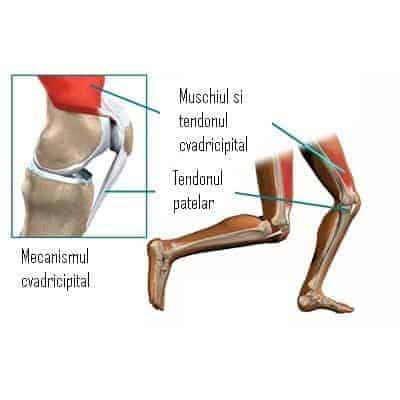
A quadriceps tendon rupture is a disabling injury. It usually requires surgical treatment to restore knee function. Quadriceps tendon ruptures can be partial — the tendon is still in one piece — or complete, presenting as two separate parts.
Written and medically reviewed by Dr. Ion Bogdan Codorean, senior orthopaedics-traumatology physician. Updated: August 14, 2026.
A quadriceps rupture usually occurs following overload with the knee flexed. One such example is an awkward landing during a basketball match. Ruptures also occur through a direct mechanism: impact to the knee against a hard surface, or a laceration.
A weakened tendon ruptures more easily. There are several situations in which the tendon may be weakened:
Very rarely, quadriceps tendon ruptures have occurred following knee surgery or dislocations.
Most small, partial tears respond well to conservative treatment.
The orthopaedic surgeon will advise on the right time to resume sporting activity.
Most patients with a complete quadriceps tendon rupture require immediate surgery to repair the torn tendon. Surgery is also an option for those with partial tears and a degenerate or weakened tendon.
The operation involves reattaching the torn tendon to the upper pole of the kneecap. Patients who need surgery do better when it is carried out soon after the injury. Early repair prevents the tendon from scarring and tightening in a higher position.
The procedure: reattaching the tendon involves passing sutures through the tendon and through bone tunnels in the kneecap. The sutures are tied at the lower pole of the kneecap. The tendon must be sutured under appropriate tension, and the position of the kneecap must be anatomical.
It is important to see a good orthopaedic surgeon early, from the moment the first symptoms appear.
Dr. Codorean offers a precise diagnosis and a personalised treatment plan.