
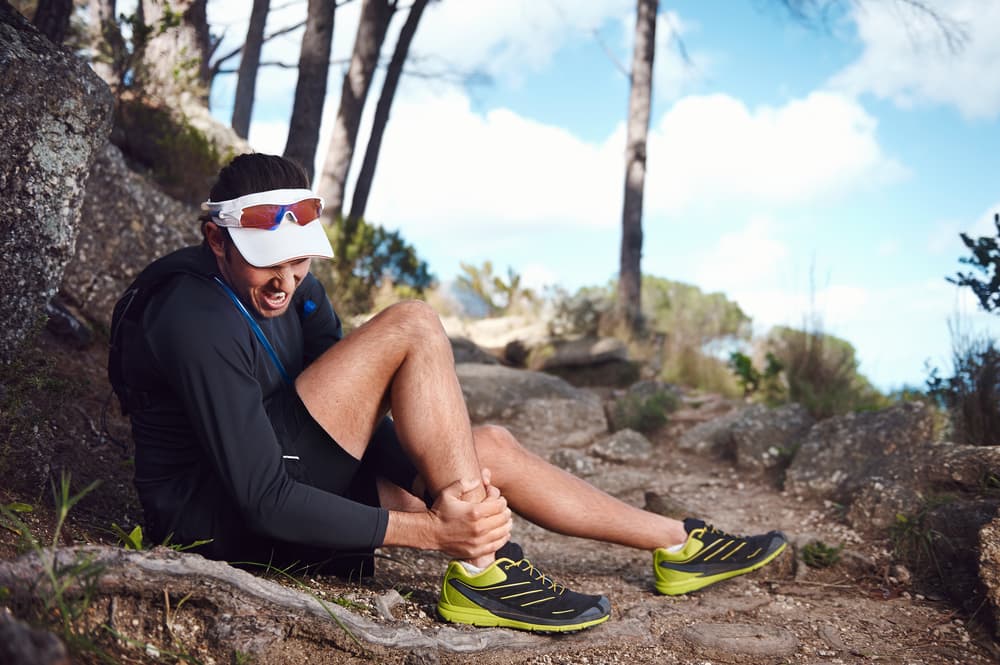
In Greek mythology, Achilles is perhaps the greatest hero of the Trojan War, yet he has a single weak point: his heel. Like Achilles, a great many athletes fear injuring this tendon and what it could mean for their performance and their career. Find out more about the Achilles tendon and the conditions that can affect it.
Written and medically reviewed by Dr. Ion Bogdan Codorean, senior orthopaedics-traumatology physician. Updated: August 15, 2026.
Also known as the calcaneal tendon, the Achilles tendon is a structure of connective tissue that links the triceps surae muscle to the heel bone — connecting the calf to the heel and allowing the foot to move during walking and running.
As the largest tendon in the human body, it is roughly 15 centimetres long and highly resistant to rupture. In adults, the average tensile strength before rupture is estimated at 192 kilograms, and the tendon can withstand a load of up to 400 kilograms. As we age this strength can fall to around 160 kilograms, which is why Achilles tendon conditions are more common in older people.
The first symptom of any Achilles tendon condition is pain. It may initially be felt as stiffness, often appearing in the morning with the first few steps. The pain becomes more pronounced through the day, each time the foot makes contact with the ground or a hard surface. Athletes feel pain particularly at the beginning and end of a training session. If the condition becomes chronic, a swelling that is painful to the touch may appear.
The most common cause of pain relates to demanding physical effort — the repeated stopping and starting of jogging or of running sports (basketball, tennis, football). Uncomfortable footwear (high heels, a poor fit) is another frequent cause.
Overloading the Achilles tendon can lead to the following conditions:
A partial rupture may cause negligible symptoms or none at all, while a complete rupture is accompanied by sudden pain and loss of movement in the foot.
The diagnosis is established by the orthopaedic surgeon after taking a history and carrying out a thorough clinical examination, which checks:
The patient will have difficulty rising onto tiptoe and, in the case of a rupture, may be unable to perform this movement at all.
For Achilles tendon conditions, the orthopaedic surgeon may recommend:
A rupture of the Achilles tendon will usually be treated surgically. There is also a non-surgical alternative — immobilising the foot in a plaster splint or a brace with the foot in plantar flexion — which allows the tendon to heal on its own, at the risk of a further rupture. Whichever method is used, a recovery period of several months follows, with kinesiotherapy and physiotherapy for mobility and calf muscle strength.
For competitive athletes or people with an intense training load:
If certain exercises cause pain around the tendon, it is advisable to avoid them and to consult an orthopaedic surgeon.
Dr. Codorean offers a precise diagnosis and a personalised treatment plan.