
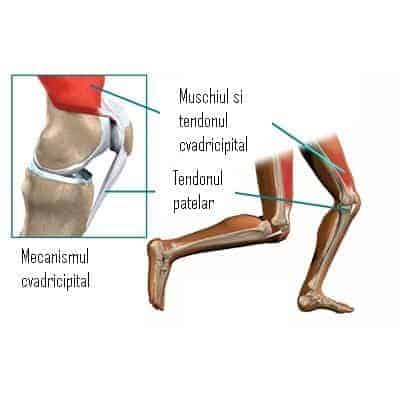
A patellar tendon rupture is a disabling injury. It usually requires surgical treatment to restore knee function.
Written and medically reviewed by Dr. Ion Bogdan Codorean, senior orthopaedics-traumatology physician. Updated: August 14, 2026.
Patellar tendon ruptures can be partial — the tendon is still in one piece — or complete, presenting as two separate parts. When the tendon is completely torn, extension is no longer possible at the knee joint. Most frequently, the patellar tendon tears at its attachment to the kneecap.
When a patellar tendon rupture is caused by a medical condition — such as tendinitis — the tendon usually tears in its central portion.
Although a patellar tendon rupture can happen to anyone, it is more common in middle-aged patients who play sports involving running and jumping.
A very large traumatic force is required for a patellar tendon rupture to occur.
A weakened tendon ruptures more easily. There are several situations in which the tendon is weakened:
Previous surgery in the vicinity of the tendon, such as total knee replacement or cruciate ligament reconstruction, is a risk factor for patellar tendon rupture.
When a patellar tendon ruptures, there is frequently a sound and a sensation of tearing. Pain and swelling then follow. Additional symptoms include:
Dr. Codorean offers a precise diagnosis and a personalised treatment plan.